First Lecture
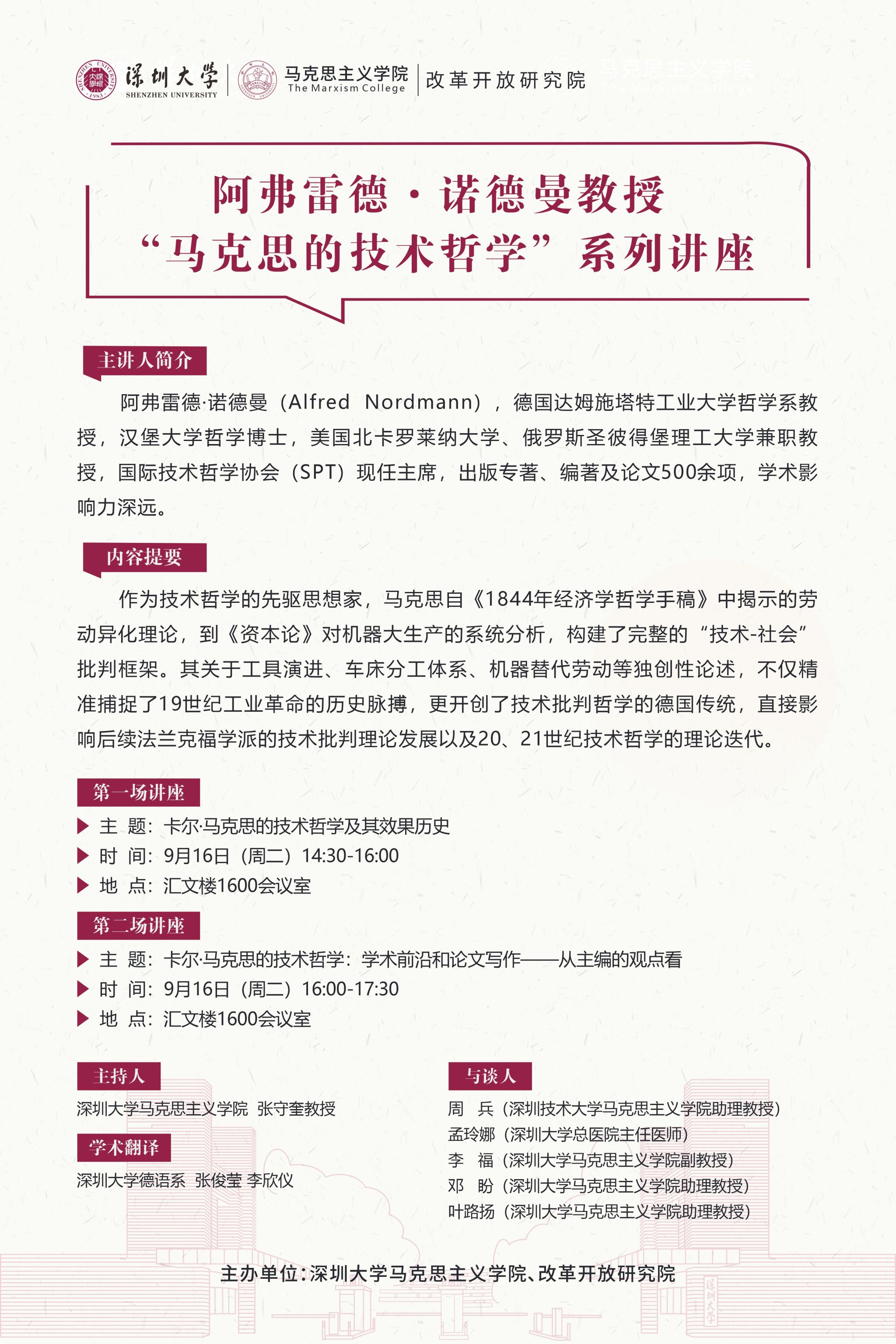
Topic: Karl Marx’s Philosophy of Technology and Its Wirkungsgeschichte (History of Effects)
Time: September 16 (Tuesday), 14:30–16:00
Venue: Huiwen Building, Room 1600
Second Lecture
Topic: Karl Marx’s Philosophy of Technology: Research Frontiers and Academic Writing — Insights from an Editor’s Perspective
Time: September 16 (Tuesday), 16:00–17:30
Venue: Huiwen Building, Room 1600
Moderator: Professor Zhang Shoukui, School of Marxism, Shenzhen University
Academic Interpreters: Zhang Junying, Li Xinyi (Department of German, Shenzhen University)
Discussants:
Zhou Bing, Assistant Professor, School of Marxism, Shenzhen Technology University
Meng Lingna, Chief Physician, Shenzhen University General Hospital
Li Fu, Associate Professor, School of Marxism, Shenzhen University
Deng Pan, Assistant Professor, School of Marxism, Shenzhen University
Ye Luyang, Assistant Professor, School of Marxism, Shenzhen University
Speaker Biography
Alfred Nordmann is Professor of Philosophy at the Technical University of Darmstadt, Germany. He holds a PhD in Philosophy from the University of Hamburg and has served as a visiting professor at the University of North Carolina (USA) and Peter the Great St. Petersburg Polytechnic University (Russia). He is the current President of the Society for Philosophy and Technology (SPT). Professor Nordmann has published more than 500 monographs, edited volumes, and academic articles, exerting extensive influence in the field of philosophy of technology.
Abstract
As a pioneering thinker in the philosophy of technology, Karl Marx developed a comprehensive “technology–society” critical framework. From his theory of labor alienation in the Economic and Philosophic Manuscripts of 1844 to his systematic analysis of machine-based large-scale industry in Capital, Marx explored the development of tools, the division of labor in lathe systems, and the replacement of human labor by machines. These original insights captured the pulse of the 19th-century Industrial Revolution and established the foundation of the German tradition of technological critique. His work profoundly influenced the Frankfurt School’s later theories of technology criticism and shaped the ongoing evolution of philosophy of technology in the 20th and 21st centuries.
Hosted by:
School of Marxism, Shenzhen University
Institute for Reform and Opening-Up, Shenzhen University
September 11, 2025