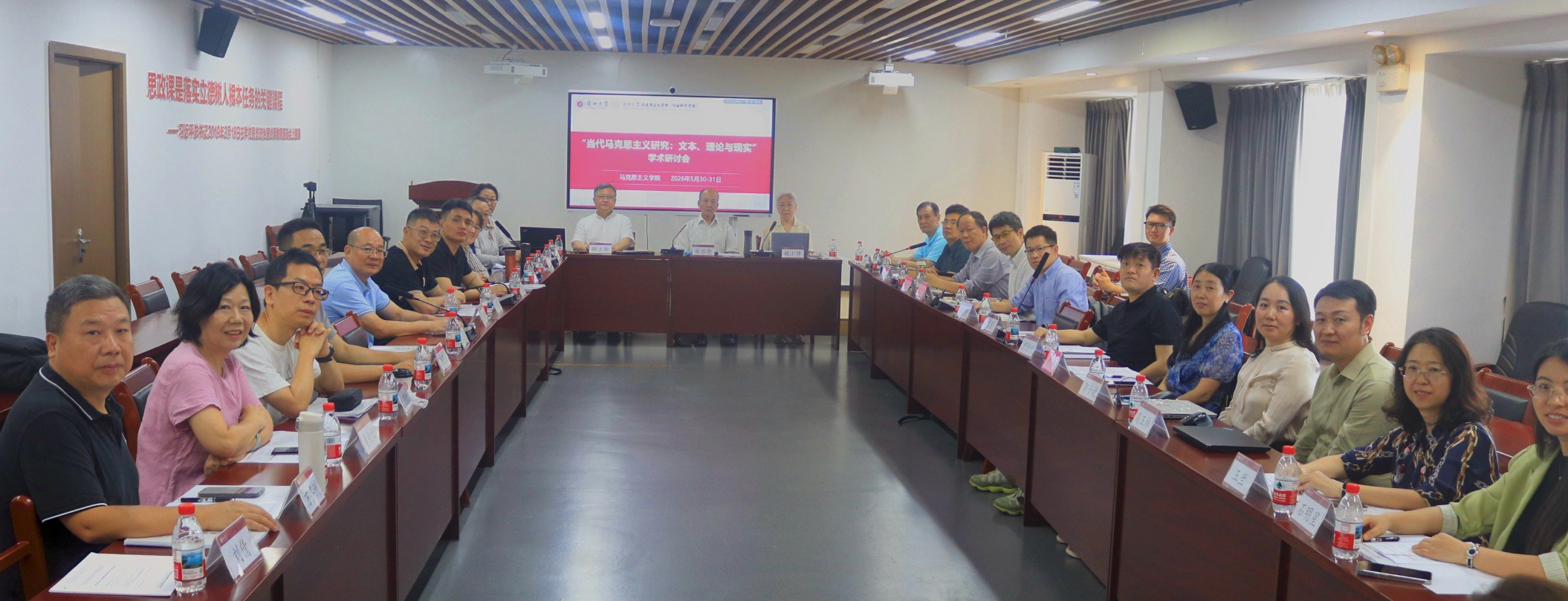
On May 30–31, 2026, the academic symposium "Contemporary Marxist Studies: Texts, Theory and Reality" — sponsored by the Branch Society for the Study of the Texts and Documents of Marx and Engels of the Chinese Society for the History of Marxist Philosophy, a national first-level academic society, and co-organized by the School of Marxism of Shenzhen University, the Guangdong Regional Collaborative Innovation Center for Ideological and Political Courses in Higher Education Institutions, and the "Fu Heming Master Teacher Studio," a Guangdong provincial master-teacher studio for ideological and political courses in higher education — was successfully held at Shenzhen University. More than 30 experts and scholars from Renmin University of China, the Chinese Academy of Social Sciences, Peking University, Fudan University, Nanjing University, Heilongjiang University and other well-known universities and research institutions across the country gathered together to conduct in-depth academic exchanges on the contemporary interpretation of classic Marxist texts, the innovative development of basic theories, and the deep integration of theory and reality.
Professor Hao Lixin, President of the Chinese Society for the History of Marxist Philosophy, a national first-level academic society, delivered an address on behalf of the sponsor, fully affirming the academic value and practical significance of the symposium. He stressed that, against the backdrop of major changes unseen in a century, advancing in-depth research on classic Marxist texts is both the academic responsibility of theoretical workers and a mission entrusted by the times. Senior Research Fellow Wei Xiaoping, President of the Branch Society for the Study of the Texts and Documents of Marx and Engels, reviewed in her address the important progress made in this field in recent years and extended a sincere welcome to the participating scholars. Professor Wang Hong, Member of the Standing Committee of the Party Committee of Shenzhen University and Secretary of the Party Committee of the School of Marxism, expressed her thanks to the sponsor and the participating experts and introduced the School's series of achievements in the field of Marxist theory research, noting that studying classic Marxist texts, the dissemination of documents and contemporary developments is the primary task of Marxist scholars.
The first keynote session was chaired by Wang Zhiqiang, senior editor of Social Sciences in China. Professor An Qinian of the School of Philosophy, Renmin University of China, pointed out that against the backdrop of profound changes in the contemporary world landscape, returning to classic Marxist texts is not a simple exercise in textual criticism but a theoretical self-renewal and reconstruction. The contemporary interpretation of Marxist classics requires grasping both the historical threads of the texts and the orientation toward real-world problems; only thus can the classics truly exert their power of intellectual guidance. Senior Research Fellow Wei Xiaoping of the Institute of Philosophy, Chinese Academy of Social Sciences, starting from Marx's labor theory of value, distinguished between digitally creative labor and digitally manipulative labor, arguing that Marx's labor theory of value still has significant explanatory force for analyzing new forms of labor in the digital economy era, and that the question of value creation in digital labor — especially creative labor — opens new analytical space for deepening Marx's labor theory of value under contemporary conditions rather than posing a challenge to the theory itself. Professor Hao Lixin of the School of Marxism, Renmin University of China, systematically reviewed the evolution of contemporary Chinese Marxist cultural theory and explored the far-reaching significance of the "second combination" at the level of cultural theory, holding that integrating the basic tenets of Marxism with China's fine traditional culture has opened a new realm for the development of socialist culture with Chinese characteristics. Professor Zhu Huanghe of the School of Marxism, Jiangxi Normal University, emphasized at both the theoretical and practical levels that Chinese modernization is not a "carbon copy" of Western modernization but a new path of modernization grounded in China's national conditions, historical and cultural traditions and socialist system, displaying distinctive theoretical features and a distinct logic of reality in such dimensions as its huge population, the pursuit of common prosperity, and the promotion of harmony between humanity and nature.
The second keynote session was chaired by Yin Chuangang, editor-in-chief of the Theory Weekly of Shenzhen Special Zone Daily. Professor Nie Jinfang of the Department of Philosophy, Peking University, distinguishing between the categories of "labor time" and "life time," argued that the essence of the capitalist mode of production lies not only in the exploitation of labor time but also in the systematic deprivation and alienation of workers' life time. Communist emancipation consists in redeeming time from the logic of capital valorization, enabling people to truly possess their own life time and restoring time to its meaning for life. Professor Wang Fengcai of the School of Philosophy, Fudan University, in light of the rapid development of artificial intelligence technology, discussed the applicability and limitations of critical theory under new technological conditions, arguing that AI technology is profoundly reshaping the relationship between humans and technology, and that earlier critical frameworks concerning technological rationality and its alienation of human beings still retain a degree of explanatory power today but need to be adjusted and expanded in line with new trends in digital development. Professor Liu Huaiyu of the School of Philosophy, Nanjing University, drawing on the theory of the production of space and the analytical framework of historical materialism, explored the production and reorganization of space in the process of Chinese modernization and put forward systematic ideas for building the relevant theoretical discourse system.
The third thematic session was chaired by Dang Wenting, a reporter for the Shenzhen bureau of Guangming Daily and a PhD of The Chinese University of Hong Kong, Shenzhen. Professor Huang Xuesheng of the School of Marxism, Sun Yat-sen University, pointed out that Capital is not merely a rigorous work of economics but also contains a profound ethical critique. This ethical critique is not an external moral exhortation but an immanent critique grounded in the normative standpoint of human creative activity. Marx's ultimate concern for the free and all-round development of human beings still holds important value for examining contemporary capitalism, curbing the disorderly expansion of capital, and advancing Chinese modernization. Associate Professor Gao Yulin of the School of Marxism, Southern University of Science and Technology, pointed out that however capital may change its appearance in new forms such as financialization and digitalization, its essence of exploiting labor and pursuing surplus value remains unchanged. Under the conditions of a socialist market economy, various forms of capital should be understood dialectically and regulated: the positive role of public capital in developing the productive forces and creating wealth should be brought into play, while the disorderly expansion of non-public capital should be restrained. Wang Lan of the School of Marxism, Shenzhen MSU-BIT University, starting from the methodology of historical materialism, analyzed the material basis of cultural subjectivity and its historical formation, and, drawing on the practical experience of socialist cultural development with Chinese characteristics, explored concrete paths for building cultural subjectivity under current conditions. Deng Pan of the School of Marxism, Shenzhen University, argued that Marx's "camera" metaphor involves not only a critique at the epistemological level but can also be extended to the analysis of the material production of the photographic industry and the alienation of labor. As the materialized crystallization of "dead labor," the camera conceals the exploitation of "living labor" while producing a spectacle of consumption; moreover, the extraction of photosensitive materials by the photographic industry, at the cost of plundering the resources of the Global South and damaging ecosystems, further intensifies the "metabolic rift." In the face of capital's monopoly over visual resources, we should turn to practices of visual resistance in the Global South and explore a historical-materialist path toward reconstructing a politics of public photography.
The fourth thematic session was chaired by Professor Zhao Yulan of the School of Marxism, Renmin University of China. Professor Tu Liangchuan of the School of Marxism, South China Normal University, argued that the rise of artificial intelligence is compelling the academic community to re-examine such basic philosophical categories as consciousness, subjectivity and labor, and explored the self-renewal that philosophical ways of thinking must undergo against the backdrop of technological revolution, holding that Marxist philosophy has a distinctive methodological advantage in responding to this challenge. Professor Zheng Xiangping of the School of Marxism, Shenzhen University, summarized the original contributions of the ecological outlook of Chinese modernization from four dimensions, arguing that it fundamentally transcends the Western dualistic framework that sets development and ecology in opposition and contributes a Chinese approach to global ecological civilization. Shi Mingxing of the School of Marxism, Shenzhen MSU-BIT University, drawing on the concept of metabolism (Stoffwechsel) in Marx's Capital, explored the metabolic relationship between the digital economy and the ecological environment, attempting to clarify the internal logic of the development of digital ecological civilization within the framework of Marxist ecological philosophy. Associate Professor Guo Xiaoshuo of the School of Marxism, Shenzhen University, interpreted Marx's conception of matter in the era of digital intelligence from the three dimensions of ontology, epistemology and the philosophy of history, arguing that the forms of matter in this era have not departed from the basic framework of Marx's conception of matter but await further creative elaboration under new technological conditions.
The fifth thematic session was chaired by Professor Tu Liangchuan of South China Normal University. Professor Ma Tianjun of the Department of Philosophy, Sun Yat-sen University, approached the topic from the perspective of textual scholarship, taking Kautsky's early editing of The German Ideology as his object of study, and examined how, against the backdrop of the social democratic movement at the end of the nineteenth century, the question of violent revolution was filtered out and reshaped in the process of editing and disseminating the text. Professor Jiang Haibo of the School of Philosophy, Heilongjiang University, systematically reviewed the intellectual sources of the Theses on Feuerbach and reconstructed Marx's reading background and theoretical sources at the time of writing, providing more solid textual scholarship for understanding his philosophical innovation. Professor Zhao Yulan of the School of Marxism, Renmin University of China, analyzed the question of the chronological formation of the manuscripts of The German Ideology, emphasizing that the editorial principles of MEGA² are not neutral technical operations but embody a particular understanding of the course of Marx's thought. She stressed that the chronological order of textual composition should be distinguished from the temporal order of intellectual logic, holding that this distinction is of important methodological significance for accurately understanding the formation of Marx's historical materialism. Zou Xinhai of the Department of Philosophy, Sun Yat-sen University, through textual comparison, found that in The Holy Family Marx drew extensively on the philosophical-historical materials of Renouvier's Manual of Modern Philosophy and transformed them through the method of "rhetorical appropriation," arguing that this transformation was a theoretical construction undertaken by Marx in order to criticize Bauer and Hegel and reflects the increasingly refined academic orientation of research on classic Marxist documents.
The sixth thematic session was chaired by Professor Fu Heming of the School of Marxism, Shenzhen University. Professor Lin Zhao of the School of Marxism, Sun Yat-sen University, attempted to re-understand the concept of "tradition" within the framework of historical materialism, pointing out that "tradition" is not something simply discarded by historical materialism but an intellectual resource awaiting re-understanding and reactivation — a perspective of important inspiration for understanding the intrinsic connection between Marxism and China's fine traditional culture. Associate Professor Wang Li of the School of Marxism, Renmin University of China, pointed out that the traditional history of materialism simply set materialism and idealism in opposition, misplacing Marx's modern materialism within the framework of idealist metaphysics. In fact, modern materialism does not retreat to a materialist ontology but advances, on the basis of the primacy of matter, to a philosophical demonstration of the real generation of the spiritual world. Marx's historical materialism explains ideological forms starting from material production, thereby achieving an intrinsic unity of nature, society and spirit. Tang Ling of the School of Marxism, Shenzhen Technology University, introduced concrete approaches to integrating digital intelligent technology into the course "Basic Principles of Marxism." Li Jie of the School of Marxism, Shenzhen University, analyzed in depth how Marx, in his youth, critically absorbed Epicurus's thinking on the subject, pointing out that this line of thinking had a profound influence on the subsequent formation of Marx's materialist philosophical outlook.
Professor Wang Fengcai, Vice President of the Branch Society for the Study of the Texts and Documents of Marx and Engels, summarized the two-day conference on behalf of the sponsor. Professor Wang expressed heartfelt thanks to the participating scholars for their enthusiastic participation and excellent presentations, noting that the symposium was held at an opportune time and that the presentations not only demonstrated the vigorous vitality of current Marxist theoretical research but also accumulated valuable intellectual resources for future in-depth research. The vitality of Marxism lies in its ability to respond to the new questions raised by the times. In the face of major issues of our time — such as the deep involvement of artificial intelligence in social life, digital technology reshaping human labor relations, and the growing urgency of global ecological civilization — Marxist theoretical workers should, with a more open posture and more solid academic grounding, continue to advance the deep integration of research on classic texts with analysis of real-world problems. He expressed the hope that participating scholars would take this conference as an opportunity to further strengthen academic cooperation and intellectual exchange and jointly contribute more valuable academic results to the contemporary development of Marxist theory.
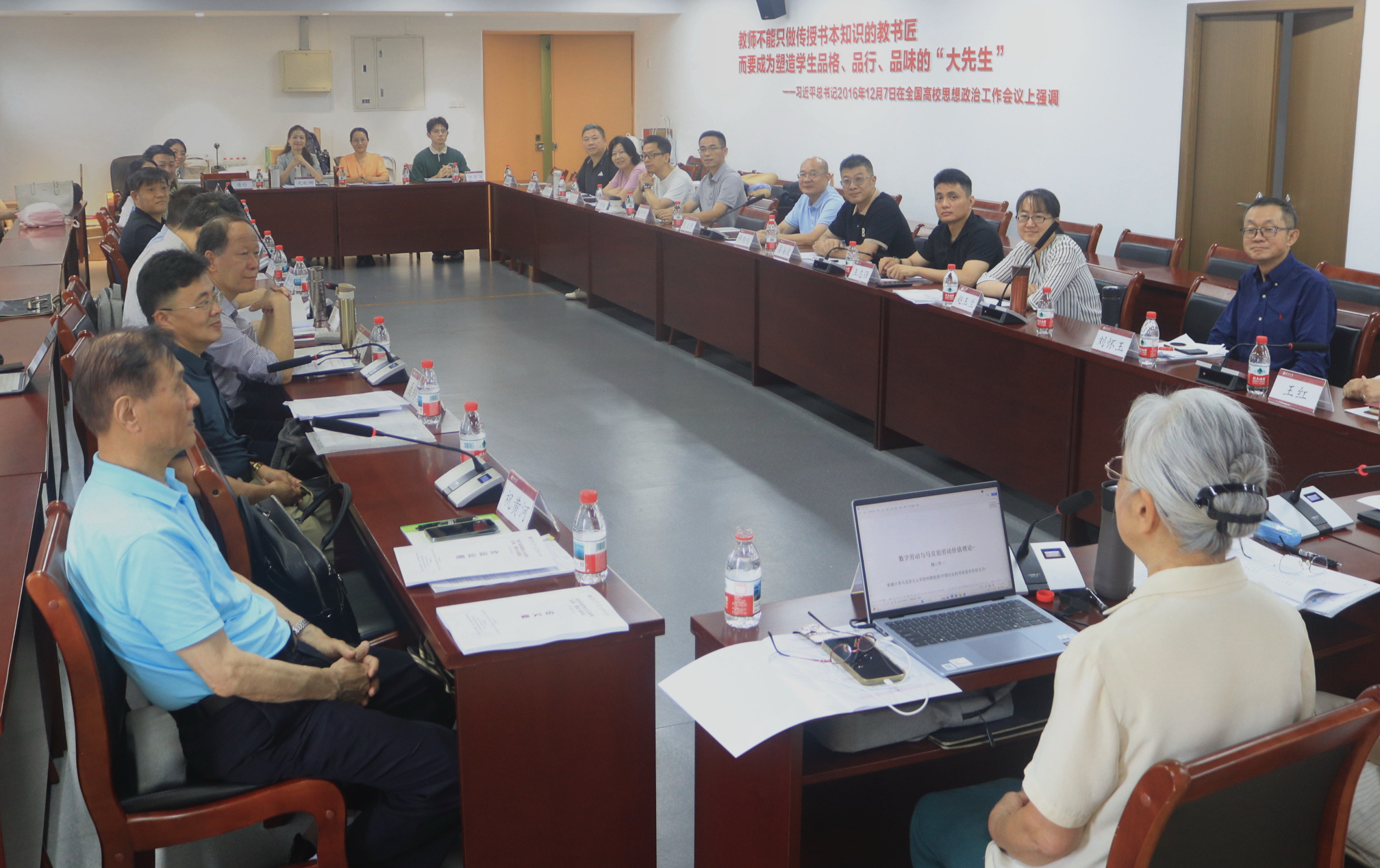
The topics covered by this symposium spanned textual research on classic documents, innovation in basic theory, critique of digital technology, ecological civilization, and the reform of ideological and political education, presenting in a concentrated way the frontier level and diverse perspectives of current Marxist theoretical research in China. The conference not only promoted in-depth exchange and intellectual collision among different research directions but also accumulated important academic resources for the continued development of Marxist theory. Participating scholars generally agreed that, in an era marked by the deep involvement of artificial intelligence in social life and the continued advancement of Chinese modernization, upholding the academic foundation of textual research, deepening theoretical innovation, and strengthening the organic connection between theory and reality are academic missions shared by all who work in Marxist research. The conference drew to a successful close in a warm and substantial academic atmosphere.