To thoroughly publicize and implement the spirit of the Fourth Plenary Session of the 20th Central Committee of the Communist Party of China, to implement the arrangements for grassroots theoretical outreach work at Guangdong's key schools of Marxism, and to bring the Party's innovative theories to the grassroots and to people's homes, the School of Marxism of Shenzhen University organized a core outreach team of its faculty and, in May 2026, sent them in batches to the districts of Zhuhai to carry out grassroots theoretical outreach, earnestly fulfilling the School's responsibilities of social service.
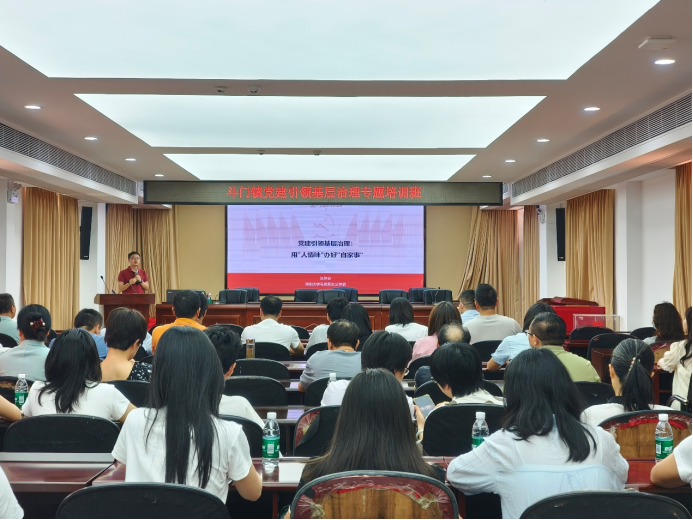
On the afternoon of May 13, 2026, five teachers of the School went to different districts of Zhuhai at the same time to carry out theoretical outreach. At the People's Government of Doumen Town, Doumen District, Associate Professor Liu Huayun gave a special lecture titled "Party Building-Led Grassroots Governance: Handling 'Our Own Family Affairs' with a Human Touch." Focusing on innovation in grassroots governance under the leadership of Party building, the lecture explored how to resolve the "warmth deficit" in grassroots governance through a human touch. Grounded in the top-level design for modernizing national governance, it explained in depth the core essence of emotional governance and how local culture and ethical relations can be transformed into governance resources. Drawing on a range of vivid cases, it illustrated the practical path of coordinated governance that integrates "emotion, reason and law." The lecture pointed out that, under the leadership of Party organizations, warm-hearted services and flexible consultation can effectively turn grassroots affairs into matters that feel close to the people.
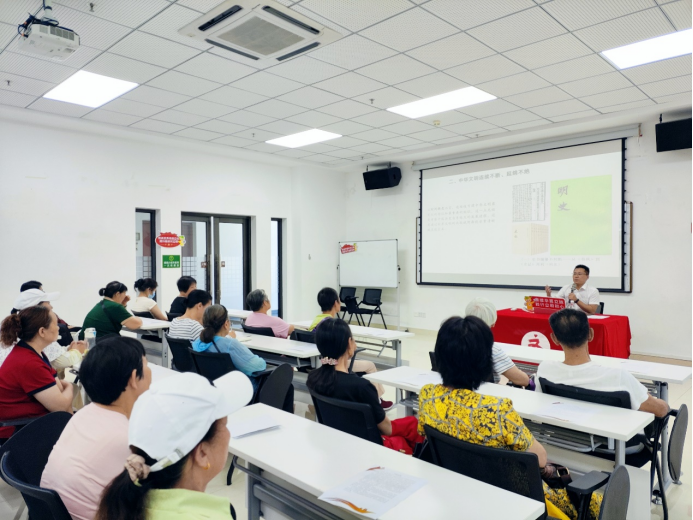
At the New Era Civilization Practice Center of the Zhuhai High-Tech Zone, Associate Professor Cai Zhuo gave a special lecture titled "The Splendid Chinese Civilization and Its Overall Characteristics." Associate Professor Cai comprehensively reviewed the main characteristics of China's fine traditional culture, citing examples such as the oracle bone script system of Chinese characters, the Dujiangyan irrigation system and the Four Great Inventions to demonstrate that Chinese civilization has a long history and has yielded rich achievements in both material and spiritual civilization. In conclusion, Professor Cai noted that Chinese civilization has accumulated abundant cultural nourishment and a spiritual foundation for contemporary development, and that accurately grasping the characteristics of this civilization is an important prerequisite for firming up cultural confidence, building the modern civilization of the Chinese nation, and promoting the creative transformation and innovative development of China's fine traditional culture.
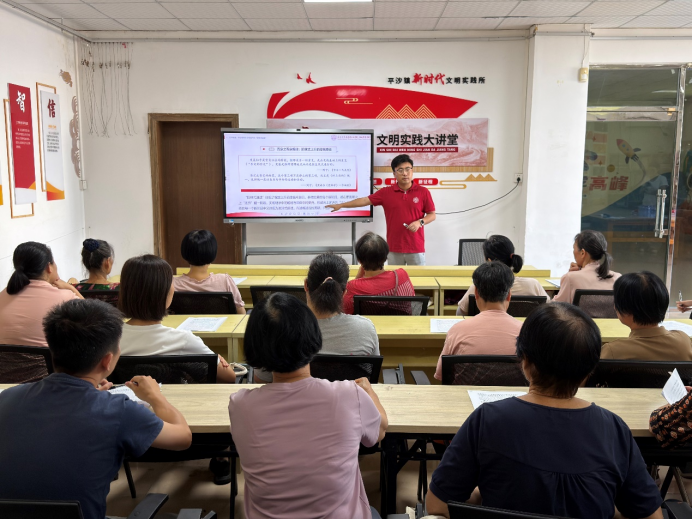
At the New Era Civilization Practice Center of Pingsha Town, Jinwan District, Assistant Professor Li Ming gave a special lecture titled "'Ascending Step by Step': The Materialist Dialectics of the 'Stepwise Progression' of Chinese Modernization and Its Global Significance." Closely following the important thesis of the Fourth Plenary Session of the 20th CPC Central Committee that "realizing socialist modernization is a historical process of stepwise progression and continuous development and progress," Li Ming interpreted the materialist dialectics embodied in this thesis from the perspective of dialectical materialism, and expounded in an all-round way the theoretical connotations and practical value of the stepwise progression of Chinese modernization along three dimensions — the evolution of temporal sequence, the echelon layout in space, and the upward leap across substantive levels. By comparing the course of modernization in China and abroad, he distilled the distinctive development features of Chinese modernization and clarified its important contribution to the theoretical system of world modernization.
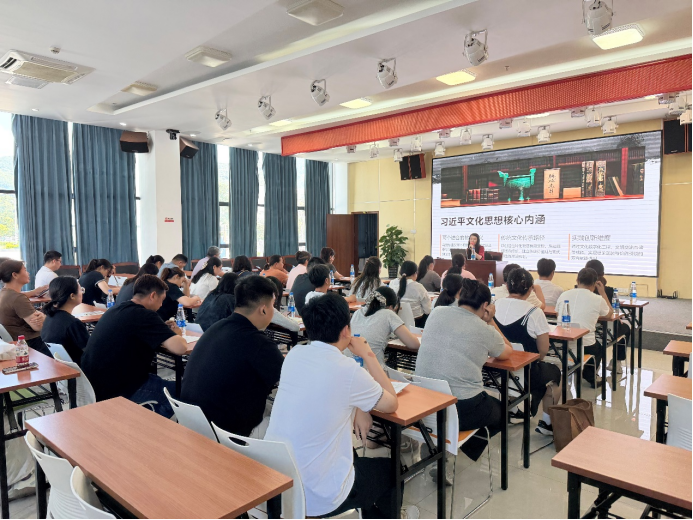
At the New Era Civilization Practice Center of Nanshui Town, Jinwan District, Assistant Professor Chen Qunyao gave a special lecture titled "Xi Jinping Thought on Culture and the Inheritance of China's Fine Traditional Culture." Chen Qunyao noted that Xi Jinping Thought on Culture regards China's fine traditional culture as the spiritual lifeline of the Chinese nation, and makes clear that abandoning traditional culture would sever the very roots of the nation's development. This thought takes the "two combinations" as its core methodology — particularly the "second combination," namely the integration of the basic tenets of Marxism with China's fine traditional culture — which endows traditional culture with renewed vitality for the times. Inheritance and development must uphold the principle of upholding fundamental principles while breaking new ground, and deeply explore such traditional values as benevolence, putting the people first, integrity, justice, harmony and universal peace, integrating them into the whole process of cultivating core socialist values, cultural-ethical development and national governance. The ultimate aim is to firm up cultural confidence, truly bring museum artifacts, heritage sites and ancient texts to life, help Chinese civilization adapt to modern development, and consolidate the cultural foundation for building the modern civilization of the Chinese nation.
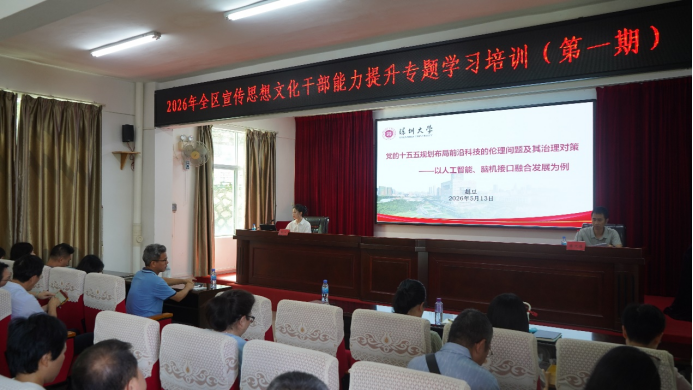
At the Activity Center for Retired Cadres in Doumen District, Assistant Professor Zhao Dou gave a special capacity-building training session titled "Ethical Issues and Governance Countermeasures in the 15th Five-Year Plan's Layout of Frontier Technologies: The Case of the Integrated Development of Artificial Intelligence and Brain-Computer Interfaces" for more than 70 cadres in publicity, ideology and culture. Centering on the directions of the frontier technology layout in the 15th Five-Year Plan, Zhao Dou analyzed the current state and application prospects of the integrated development of artificial intelligence and brain-computer interfaces, as well as the developmental forms of artificial general intelligence and digital avatars, sorted out at the level of the ethics of science and technology the various problems arising from technological convergence, and formulated multi-level ethical governance approaches spanning technology, the individual and society.
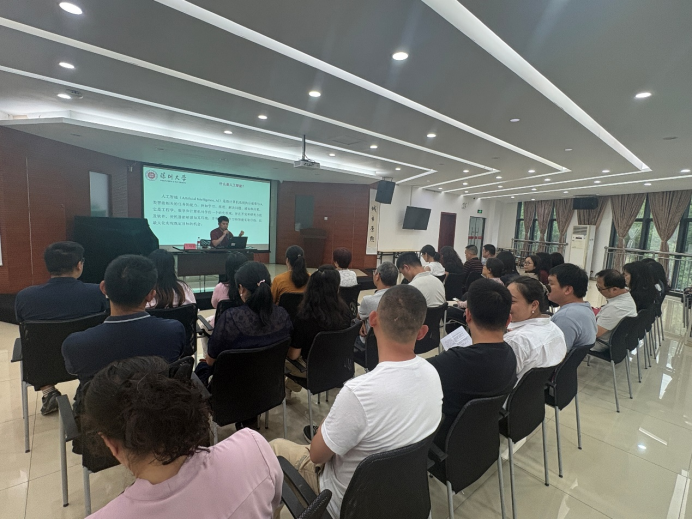
On the afternoon of May 20, Assistant Professor Chen Xiangyu came to the Shishan Subdistrict Citizens' Art Center in Xiangzhou District, bringing a special lecture titled "Philosophical and Social Reflections on the Development of Artificial Intelligence." Chen Xiangyu noted that the development of artificial intelligence has long transcended the realm of computer science and become a major issue involving both sociological exploration and philosophical speculation. Today we must consider not only the boundaries of technological application, but also the positioning of human beings and the direction of social development amid technological iteration. The lecture provided an in-depth analysis of the various real-world challenges brought by the development of artificial intelligence from three levels: philosophical ontology, ethical and moral constraints, and the impact on social structures.
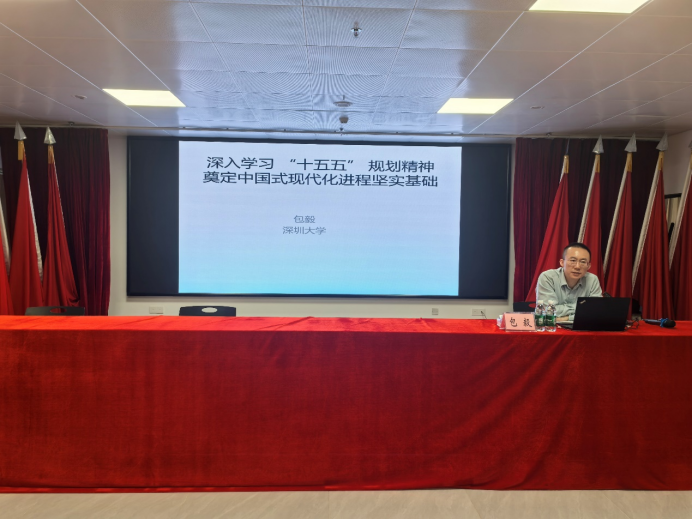
On the morning of May 22, Associate Professor Bao Yi went to the Lianquan Community Party-Masses Service Center in Xiangzhou District to deliver a theoretical lecture titled "Deeply Studying the Spirit of the 15th Five-Year Plan to Lay a Solid Foundation for the Process of Chinese Modernization." The lecture covered the great significance of formulating and implementing five-year plans, the historical position of the 15th Five-Year Plan period, the strategic arrangements for economic and social development, and striving to achieve decisive progress in socialist modernization. The language was plain and down-to-earth, translating specialized theory into everyday language that the public can readily understand, conveying the spirit of the policies in an unobtrusive way and ensuring the effectiveness of the outreach and study.
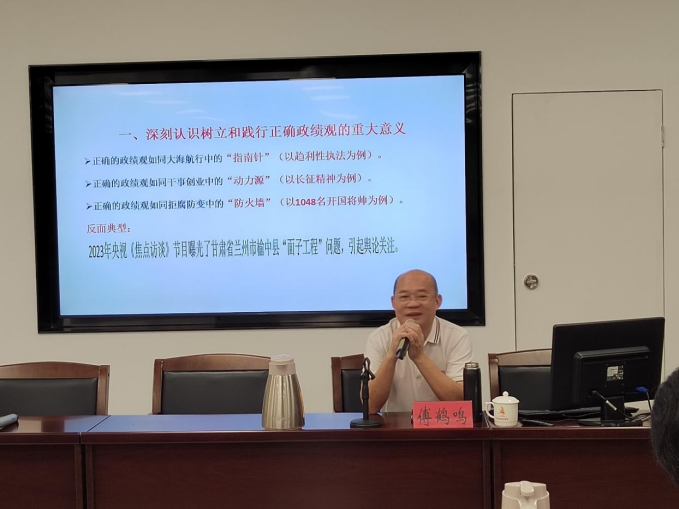
On the afternoon of May 22, Professor Fu Heming gave a special outreach and training session titled "Firmly Establishing and Practicing a Correct View of Political Achievements and Striving to Write a New Chapter of High-Quality Development" at the Party School of Fengshan Subdistrict, Xiangzhou District. More than 90 people took part in the study, including members of the subdistrict leadership team, heads of various departments, stations and offices, secretaries of community Party committees, secretaries of Party organizations in "two new" organizations, and Party members from government offices. Grounded in theoretical depth and attuned to grassroots realities, Professor Fu Heming lectured systematically along four dimensions — great significance, scientific essence, practical path, and standards for officials to follow in practice — likening a correct view of political achievements to a compass, a source of motivation and a firewall for undertaking work and starting businesses. Drawing on both positive and negative typical cases, he analyzed the erroneous view of political achievements bred by formalism and bureaucratism, pointed out the harms of problems such as seeking quick success and instant benefits, vanity projects, and placing greater weight on paperwork than on substance, and explained that one's view of political achievements is the concentrated embodiment and fundamental test of a Party member cadre's worldview, outlook on life and values. Closely following the core proposition of "who am I, for whom do I work, and on whom do I rely," he interpreted the essence of the view of political achievements, and, using real practical cases, explained that the effectiveness of work must withstand the triple test of practice, the people and history. At the same time, he put forward specific requirements for Party member cadres in practicing a correct view of political achievements from four aspects: tempering Party spirit, strengthening theoretical arming, enhancing overall capability, and cultivating a fine work style. The entire lecture was rigorous in logic, vivid in examples and substantial in content, combining theoretical depth with grassroots warmth and giving the participating Party member cadres a profound course in ideological education and Party spirit tempering.
This year, the School of Marxism of Shenzhen University and the Publicity Department of the CPC Zhuhai Municipal Committee have carried out pairing and joint development, with plans to conduct a total of 20 grassroots theoretical outreach activities. Giving full play to its disciplinary and theoretical strengths, the School has offered a series of theoretically solid lecture courses that fit the grassroots context, promoting the implementation of the Party's innovative theories and the latest plenary session spirit at the local level, helping to raise the theoretical literacy and cultural confidence of the people at the grassroots, building consensus in thinking and gathering strength for forging ahead, and contributing theoretical wisdom to the local development of Zhuhai.
School of Marxism, Shenzhen University
May 26, 2026