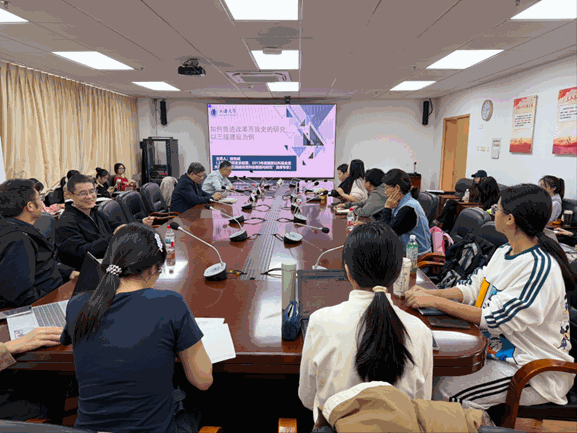
On the afternoon of December 5, 2025, the "Grand Lecture Series on Reform and Opening Up and the Practice of the Shenzhen Special Economic Zone," hosted by the School of Marxism and the Research Center for the History of Reform and Opening Up, Shenzhen University, was successfully held in Meeting Room 1600, Huiwen Building, Yuehai Campus, Shenzhen University. Prof. Xu Youwei, a Grade-II Professor in the Department of History at Shanghai University and chief expert of the major project of the National Social Science Fund titled "The Compilation and Study of Materials on the 'Small Third Front' Construction," delivered a brilliant lecture titled "How to Advance Research on the History of Reform and Opening Up: The Case of the Third Front Construction" to the faculty and students of Shenzhen University. The lecture was chaired by Prof. Xu Jianhua of the Research Center for the History of Reform and Opening Up, Shenzhen University, and was attended by faculty members and students of the University.
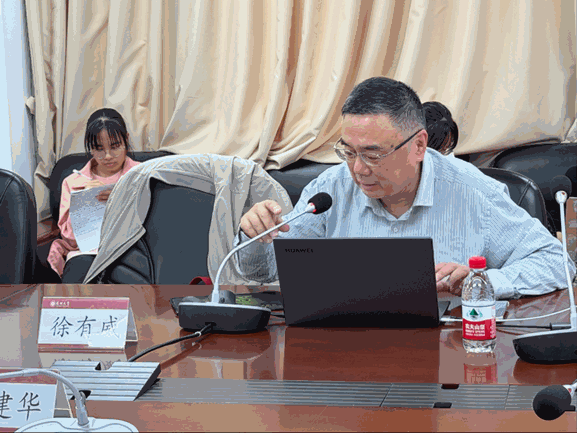
At the outset of the lecture, Prof. Xu Youwei pointed out that the Third Front Construction was a large-scale strategic industrial relocation and national defense undertaking in the history of New China, and that in-depth study of this period of history is of great methodological significance and empirical value for advancing research on the history of reform and opening up as a whole. He then elaborated on the theme from three aspects.
First, Prof. Xu Youwei explained the historical background, great achievements and spiritual legacy of the Third Front Construction. He recalled that, beginning in 1964 and in response to a grave international situation, the state carried out large-scale, war-preparedness-centered construction across 13 provinces and autonomous regions in the central and western parts of the country. Spanning three Five-Year Plans, the undertaking absorbed more than 205 billion yuan in investment and produced some 2,000 large and medium-sized enterprises, research institutes and infrastructure facilities. Responding to the call that "the best people and the best equipment should go to the Third Front," millions of builders forged, amid harsh conditions, the "Third Front spirit" centered on "hard struggle and pioneering work, selfless dedication, unity and collaboration, and the courage to innovate," making indelible contributions to optimizing the nation's industrial layout and consolidating national defense. This period of history is a key chapter for understanding how New China independently advanced its industrialization and pursued a strategic depth-based layout.
Second, Prof. Xu Youwei gave a systematic account of the rich achievements in current research on the Third Front Construction and the contemporary value of its diverse research methods. As an authoritative scholar in the field, he presented the substantial results achieved by his team in compiling source materials (for example, a compilation of archival documents totaling 231 million characters), collecting oral histories and academic publishing (as editor-in-chief of the ten volumes of the Research Series). He noted that research has moved from macro-level narrative into micro-level enterprise history and the history of social life, and that interdisciplinary methods are widely employed. At the same time, the revitalization and adaptive use of Third Front heritage has become a new trend — for instance, student research projects in the "Challenge Cup" competition and localities developing culture and tourism based on former sites — reflecting a practical path by which historical research empowers local development. Research in this field is itself flourishing, with the number of related National Social Science Fund project grants reaching a new high in 2024.
Finally, Prof. Xu Youwei offered an in-depth discussion of the implications and pathways for deepening research on the history of reform and opening up, taking the Third Front Construction as a case. He stressed that the Third Front Construction and its adjustment process of conversion from military to civilian production in the early 1980s were themselves an organic component of the grand process of reform and opening up, reflecting the historical continuity of national strategy as it shifted from war preparedness to a focus on economic development. Studying the Third Front Construction helps break the "coastal-centered" perspective that prevails in research on the history of reform and opening up, bringing the industrial foundations, institutional changes and population movements of the inland regions into the overall narrative, and thereby constructing a more complete, three-dimensional and coherent history of contemporary China. He encouraged researchers to make intensive and meticulous efforts in this field, drawing on detailed archives, vivid oral histories and diverse theoretical tools, and to contribute new knowledge. In the interactive session of the lecture, faculty members and students exchanged views with Prof. Xu Youwei on such questions as "the contemporary implications of the transformation of Third Front enterprises" and "the value of oral history methods in historical research," and Prof. Xu offered professional and detailed answers to each of the questions raised.
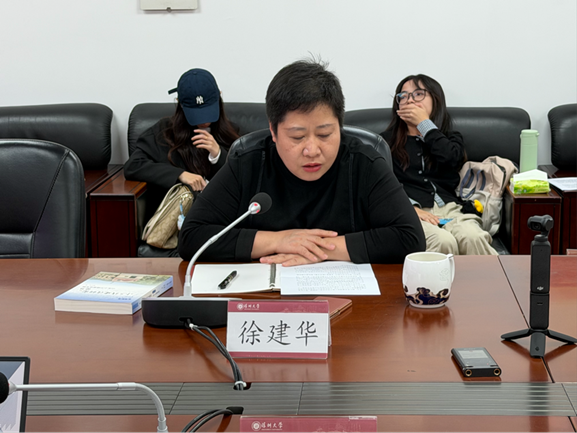
At the end of the lecture, the moderator, Prof. Xu Jianhua, thanked Prof. Xu Youwei for his brilliant presentation and delivered concluding remarks, noting that the lecture was rich in historical materials, broad in vision and profound in insight, and that it not only deepened the audience's understanding of the history of the Third Front Construction but also provided a valuable methodological model for conducting solid research on the history of the People's Republic of China and the history of reform and opening up. The lecture drew to a successful close amid warm applause from the faculty and students.