In November 2025, the School of Marxism at Shenzhen University organized a faculty lecture team to deliver the final round of grassroots theoretical publicity activities for the year across various districts of Shenzhen, conducting sessions at local New Era Civilization Practice Centers (stations and institutes). Centering on the Party’s innovative theories and the latest guiding principles, the lecturers tailored their content to local conditions and community needs, presenting complex theories in accessible and relatable ways, bringing the Party’s theoretical guidance directly to thousands of households.
Professor Wang Shuangyin — Luoho District (Nov 6)
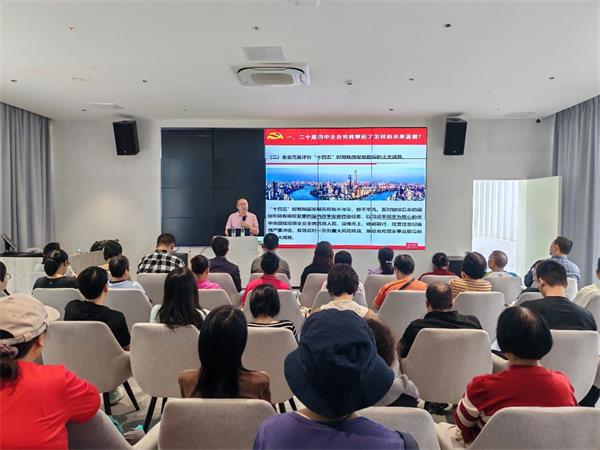
Professor Wang Shuangyin delivered a lecture titled “Studying and Implementing the Spirit of the Fourth Plenary Session of the 20th CPC Central Committee” at the Luohu District New Era Civilization Practice Center. Focusing on two key questions—What future roadmap does the Fourth Plenary Session outline? and How should its guiding principles be implemented in practice?—Wang provided a detailed and comprehensive explanation. He emphasized that implementing the plenary spirit requires adhering to the core principles of “deep learning and full understanding, pragmatic action, and benefiting the people.” He explained how to translate the plenary’s strategic plans into concrete results: strengthening ideological foundations through deep study, refining task lists through alignment with the plenary spirit, solving grassroots challenges through problem-oriented approaches, and building synergy through Party leadership.
Associate Professor Sun Tingting — Longhua District (Nov 7)
Associate Professor Sun Tingting delivered a lecture titled “Cultural Confidence: The Spiritual Bedrock of the Great Rejuvenation of the Chinese Nation.” The lecture covered four core themes:
The essence and significance of cultural confidence as a marker of national identity;
The profound historical roots of cultural confidence across 5,000 years of civilization and a century of struggle;
The role of cultural confidence as the spiritual foundation for national rejuvenation in the new era;
Practical paths for sustaining cultural confidence through preservation and innovation.
Her lecture aimed to deepen public understanding of the Party’s innovative theories and strengthen the ideological cohesion necessary for unity and progress.

Assistant Professor Lu Yanduo — Dapeng New District (Nov 11)
In Dapeng Subdistrict, Lu Yanduo delivered a lecture titled “From Top-Level Design to Grassroots Implementation — Decoding the Fourth Plenary Session in Practice.” Anchoring her lecture in the plenary’s focus on national governance modernization, she constructed a three-part analytical framework: theoretical origins, practical pathways, and case studies. She illustrated the transformation of policies from macro-level planning to micro-level execution, offering clear guidance for resolving grassroots governance bottlenecks. Participants expressed renewed confidence in translating the plenary spirit into effective local governance.

Lecturer Luo Jing — Dapeng New District (Nov 11)
On the same day, Luo Jing delivered a lecture titled “Studying and Implementing the Fourth Plenary Session — Writing a New Chapter of Chinese Modernization Through Continuous Struggle.” She provided an in-depth interpretation of Chinese-style modernization, reviewing its historical evolution and analyzing the plenary’s strategic deployment for its future advancement. Her talk helped participants gain a systematic understanding of the plenary spirit’s theoretical essence.

Associate Professor Ren Heng — Shenshan Special Cooperation Zone (Nov 18)
At the Shenshan New Era Civilization Practice Center, Ren Heng delivered a lecture titled “Why the Communist Party of China Can Succeed: Lessons from Mao Zedong’s Military Strategy for Today.” Ren focused on the essence of Mao’s strategic thought, including the integration of politics and military strategy, the principle of “active defense,” the idea of “never initiating aggression but resolutely counterattacking,” and the strategic logic of gaining initiative through protracted struggle. Drawing on historical examples—from the War to Resist U.S. Aggression and Aid Korea to the liberation of Shanghai—he illustrated how military success is inseparable from winning the support of the people.

Assistant Professor Ye Luyang — Xiaomo Subdistrict (Shenshan Zone)
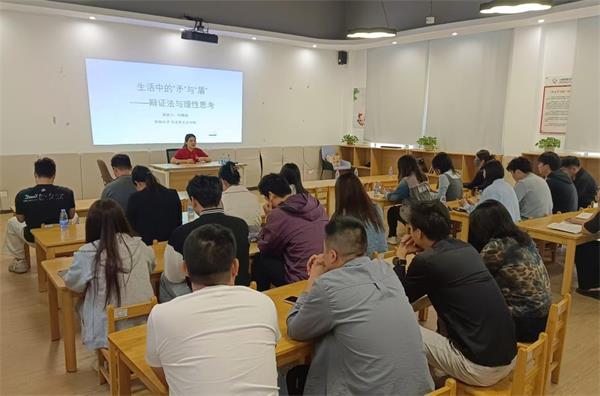
Ye Luyang presented a vivid and insightful lecture titled “The Spear and the Shield in Daily Life — Dialectics and Rational Thinking.” Starting from relatable everyday scenarios, Ye explained how contradictions govern the development of all things. Drawing on On Contradiction, the principles of universal and particular contradictions, internal and external causes, and the law of unity of opposites, he mapped a lineage of dialectical thought from the Yin-Yang concept and Laozi to Heraclitus, Hegel, and Marx. He emphasized the importance of dialectical thinking amid emerging contradictions in digital economy and AI development, such as efficiency versus ethics and innovation versus regulation.
Assistant Professor Chen Qunyao — Chishi Subdistrict (Shenshan Zone)
Chen Qunyao delivered a lecture titled “Rooting Chinese Culture, Channeling Contemporary Trends — Cultural Inheritance and Development in Chishi.” Using the theme of the “two integrations,” she framed traditional objects and customs as the “roots of culture” and modern technology and information as the “currents of contemporary thought.” Through local cases—such as Chishi’s ancient post-road revitalization and agricultural innovation—she explained:
“Integrating Marxist basic principles with China’s concrete realities” means basing actions on actual conditions;
“Integrating with fine traditional Chinese culture” means innovating through inheritance.
She encouraged participants to be transmitters of culture in their families, contributors in their villages, and “clear-minded citizens of the new era.”

Assistant Professor Lu Yanduo — Houmen Subdistrict (Shenshan Zone)
Also in the Shenshan zone, Lu Yanduo delivered another session of her lecture “From Top-Level Design to Grassroots Implementation,” again offering a systematic explanation of governance modernization, practical transformation, and case-based learning to guide grassroots cadres.

Professor Zhang Shoukui — Luohu District (Nov 25)
At the Luohu District Liantang Border Inspection Station, Professor Zhang Shoukui delivered a lecture titled “Studying the Fourth Plenary Session and Continuing to Advance Chinese Modernization.” He highlighted the plenary’s new conclusions and requirements regarding modernization and explained how to transform its spirit into firm conviction, strategic thinking, and concrete action. Emphasizing high-quality development, he called for persistent efforts to address modernization challenges and contribute collective wisdom and strength to China’s continued progress.

Assistant Professor He Jie — Nanshan District (Dec 5)
At the Nanshan District New Era Civilization Practice Center, He Jie delivered a lecture titled “Policy Interpretation of the CPC Central Committee on the Development of the Digital Economy.” Using data and case examples, he vividly explained policies promoting the integration of the digital and real economies since the 18th CPC National Congress. The lecture was warmly received by the community.

As a provincial key School of Marxism, Shenzhen University’s School of Marxism bears the mission of bringing the Party’s innovative theories to grassroots cadres and the public. In 2025, the School delivered 32 theoretical publicity sessions across Shenzhen’s districts, successfully completing the task entrusted by the Publicity Department of the Guangdong Provincial Party Committee. Communities and subdistricts across the city responded with overwhelming enthusiasm, with many requesting additional lecture sessions.
Moving forward, the School of Marxism will continue contributing to the popularization and public dissemination of the Party’s innovative theories.