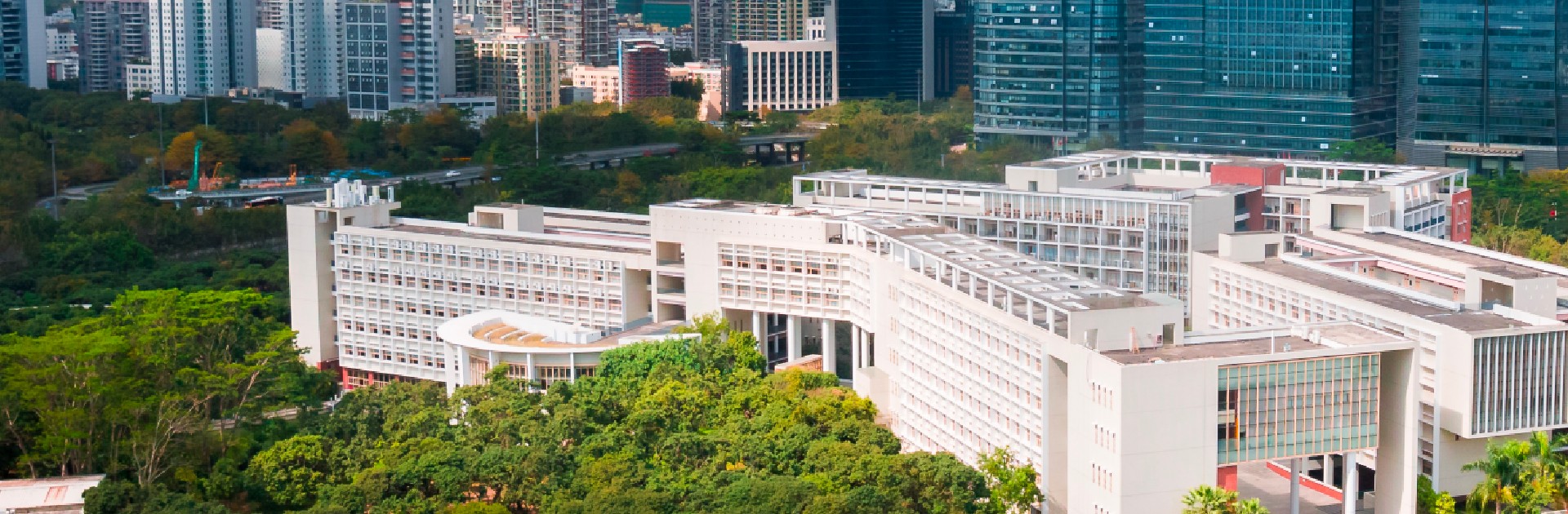
On the morning of November 25, 2025, the School of Marxism successfully held the third session of the Master Lectures Series under the Graduate Training Quality Enhancement Project of the Marxist discipline, titled “Cultivation and Refinement: Historical Sources, Methods, and the Pursuit of Academic Excellence,” in Room 1600 of Huiwen Building. The lecture featured Professor Li Xiang—chief expert of a major National Social Science Fund project, Chutian Scholar Distinguished Professor of Hubei Province, Executive Dean of the School of Marxism at Harbin Institute of Technology (Shenzhen), and a second-tier professor—as the keynote speaker. The event was chaired by Deputy Dean Sun Tingting, with more than 30 faculty members and students in attendance.
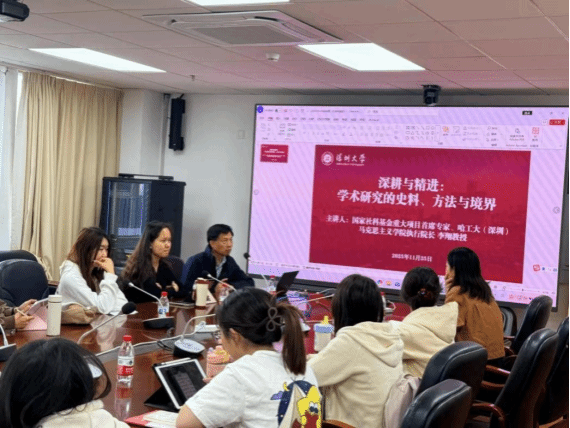
At the outset, Professor Li introduced the lecture by reflecting on his decades-long academic journey in the study of modern Chinese history. He noted that scholarship offers no shortcuts: profound academic interest is the internal driving force, while persistent effort is the essential nourishment for intellectual achievement—both indispensable and mutually reinforcing. Commenting on evolving expectations for postgraduate training in the new era, he stressed that regardless of changes in evaluation systems or training standards, researchers of Marxist theory must never lose their reverence for scholarship nor diminish their passion for theoretical inquiry. These, he emphasized, are the original aspirations and steadfast commitments of scholars in the Marxist discipline.
Drawing from his extensive research experience, Professor Li highlighted the foundational importance of historical-source excavation and literature-based research. Marxist theoretical studies, he emphasized, rely on solid historical evidence and thorough literature reviews as prerequisites for scholarly innovation. “To do academic research, one must be willing to ‘sit on the cold bench,’” he remarked. “It requires broad collection, deep excavation, repeated verification, and sustained reflection in order to extract genuine insight from vast materials.” He encouraged students to make full use of rich digital resources, databases, and archival platforms in the new era—expanding the breadth of source collection while deepening the analytical rigor of literature research—so that mastery of historical evidence becomes the firm foundation of their academic endeavors.
Professor Li further argued that systematic thinking is a core competence for academic research. Faced with complex theoretical issues, only by developing comprehensive and dialectical analytical frameworks can scholars clarify logical structures and grasp underlying patterns. He pointed out that interdisciplinary integration has become an inevitable trend in contemporary scholarship. Graduate students in the Marxist discipline should not confine themselves to disciplinary boundaries; instead, they should actively explore classics and cutting-edge works in history, sociology, political science, and related fields to broaden their intellectual horizons and enrich their analytical perspectives. “Academic innovation requires courage and determination,” he noted, urging students to remain grounded in the classics while also daring to break from conventional paradigms, explore new analytical angles, and propose original viewpoints that reinvigorate Marxist theoretical research with vitality.
As the lecture drew to a close, Professor Li shared an inspiring line from People’s Daily: “A firm aspiration should be steady rather than hurried; success lies in perseverance, not speed.” His lecture was rich in content, sharp in insight, theoretically profound yet practically meaningful. Delivered in clear and accessible language, it deeply resonated with the audience and received warm applause.
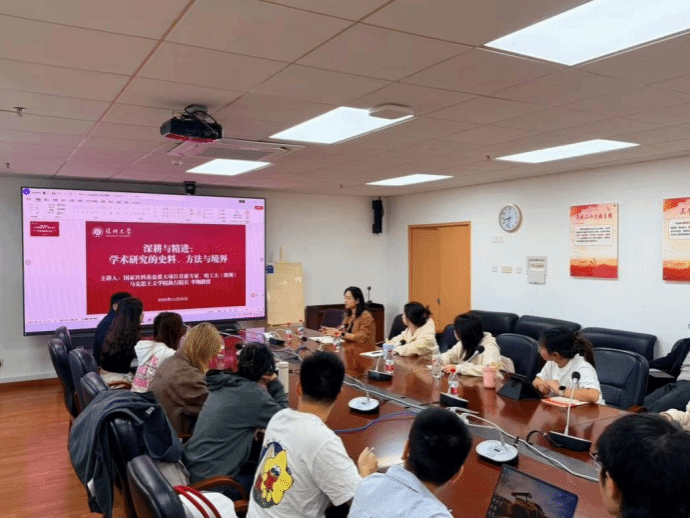
In her concluding remarks, Deputy Dean Sun Tingting praised Professor Li’s insights—from academic aspirations and source accumulation to methodological innovation and life reflection—as valuable guidance for scholarly growth. She encouraged students to transform the insights gained from the lecture into concrete academic practice: to remain true to their academic aspirations, strengthen foundational skills, pursue innovation courageously, and strive for excellence in Marxist theoretical research. She also reaffirmed the School’s commitment to advancing the Graduate Training Quality Enhancement Project, providing students with more platforms for exchange and learning, and continuously elevating the School’s talent cultivation capacity.