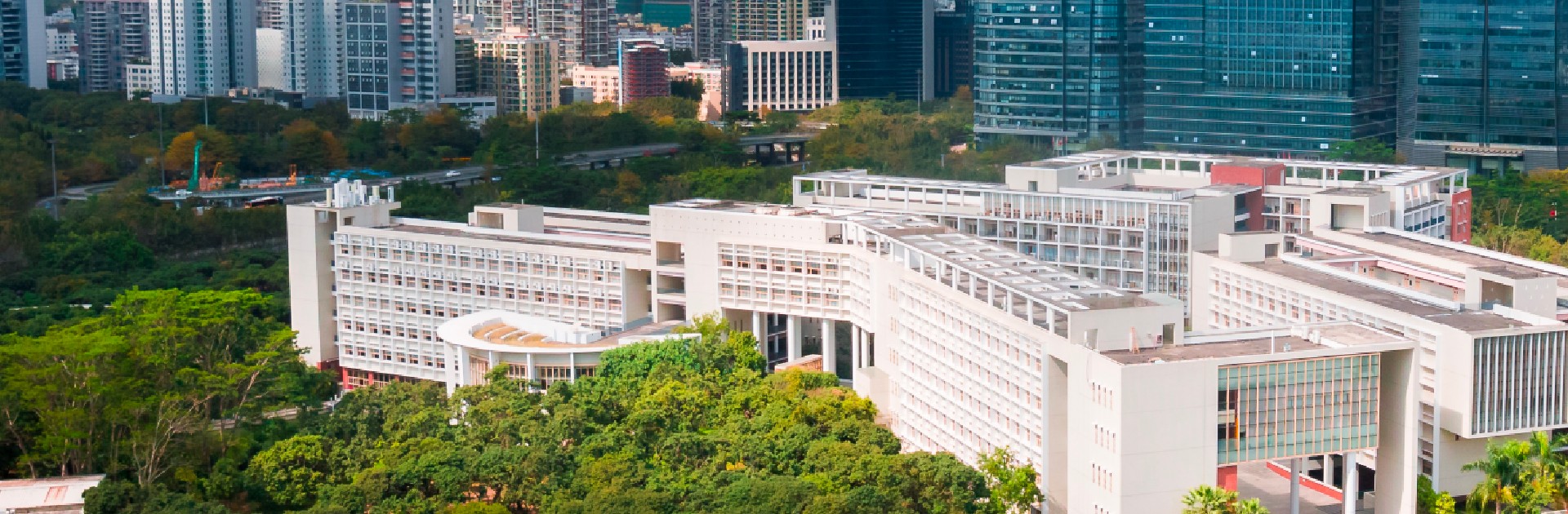
On the morning of November 11, 2025, the lecture hall H4-101 in Huiwen Building at Shenzhen University was filled with a solemn and vibrant academic atmosphere as Professor Xia Wenbin—Dean and Chair Professor of the School of Marxism at Southern University of Science and Technology, Research Fellow of the School of Marxism at Peking University, doctoral supervisor, chief expert of a major National Social Science Fund project, and a highly regarded scholar in the fields of higher education reform and regional innovation—was invited to deliver a special report titled “Integrated Reform of Education, Science and Technology, and Talent, and New Opportunities for Shenzhen.” Focusing on theoretical innovation and Shenzhen’s practical experience in promoting the coordinated integration of education, science and technology, and talent, the lecture attracted over one hundred PhD students and young faculty members from across the university.
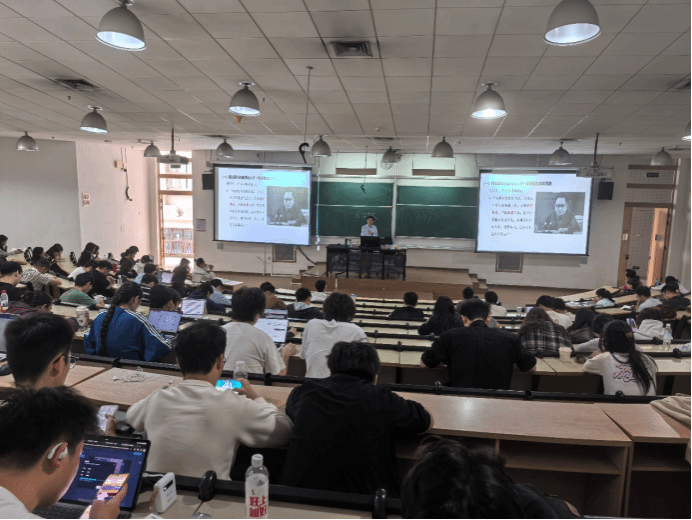
Professor Xia systematically elaborated on the core essence of the integrated reform of education, science and technology, and talent, emphasizing that it constitutes a foundational and strategic support for fully advancing Chinese-style modernization. It also carries pioneering significance for Shenzhen as it strives to become a model city of a modern socialist power. His report unfolded along four major dimensions: its strategic importance, global experience, opportunities within the Guangdong-Hong Kong-Macao Greater Bay Area, and Shenzhen’s reform pathways.
First, regarding the strategic importance of the reform for Shenzhen, Professor Xia stated that as the frontier of reform and opening-up, Shenzhen must use the “three-in-one” reform as a key engine for serving national strategies. Citing the CPC’s 20th National Congress “two-step” strategy and Shenzhen’s “three-step” development goals, he explained that the integrated reform enables Shenzhen’s transition from “manufacturing-driven” to “innovation-led” development, while its full-chain innovation ecosystem offers replicable experiences for the entire country. He stressed that the reform is crucial for developing new quality productive forces and that Shenzhen must deepen institutional reforms around its “20+8” industrial clusters and the “six 90%” innovation characteristics of local enterprises, thus fostering a virtuous cycle among education, science and technology, and talent.
Second, turning to global experiences of leading innovation cities, Professor Xia compared international benchmarks such as Silicon Valley, London, Tokyo, and Munich, as well as domestic cases like Beijing’s Zhongguancun, Shanghai’s Zhangjiang, and Hangzhou. He concluded that the “policy–education–technology–talent” quadruple-helix synergy forms the core of a robust innovation ecosystem. He noted, for instance, that Silicon Valley drives industrial iteration through a closed loop linking capital, technology, and talent, while London’s White City cluster was shaped through tripartite governance among universities, government, and industry. Shenzhen, he argued, should draw on their strengths in openness, institutional flexibility, and spatial integration to accelerate its formation as a global hub for science and technology innovation, talent development, and education.
Third, Professor Xia examined the new opportunities brought by the integrated development of the Guangdong-Hong Kong-Macao Greater Bay Area. He pointed out that overlapping policies in the Greater Bay Area expand Shenzhen’s geographical, institutional, and cultural space. By breaking regional barriers and promoting the cross-border flow of resources, Shenzhen can leverage platforms such as the “Alliance of Guangdong-Hong Kong-Macao Universities” and international sister-city networks to attract and cluster innovation factors. Drawing on Marxist spatial theory, he explained how the Greater Bay Area construction helps resolve “spatial alienation” and improves fairness and efficiency in resource allocation. Using Guangming Science City and the Hetao Cooperation Zone as examples, he illustrated how regional coordination deepens Shenzhen’s development potential.
Fourth, Professor Xia outlined new pathways for Shenzhen’s implementation of integrated reform. He proposed the overarching framework for establishing the “China–Shenzhen Demonstration Zone for Science and Technology Innovation and Global Cooperation,” suggesting efforts in four key areas: coordinated policy mechanisms, collaborative education innovation, techno-industrial integration, and optimized talent cultivation and introduction. He cited Shenzhen’s achievements—such as the simultaneous enhancement of scale and quality in higher education, industry-education integration in vocational education, and strengthened science education in basic schooling—arguing that the integration of science and education should be leveraged to nurture new quality productive forces, while talent policies should build a closed loop of “attraction, cultivation, retention, and utilization.” Ultimately, Shenzhen must develop an educational highland, an innovation source, and a talent hub that match its strategic positioning.
In closing, Professor Xia addressed young scholars directly: “Shenzhen is reshaping innovation paradigms with the resolve suited to a world undergoing profound changes unseen in a century. You must root your academic research in the vivid practice of integrated reform in education, technology, and talent, and contribute your wisdom to the建设 of the Pilot Demonstration Area of Socialism with Chinese Characteristics.” He highlighted Shenzhen’s leap from having a “higher education shortcoming” to developing the Xili Lake International Science and Education City, underscoring the importance of institutional innovation and strategic determination. He expressed great expectations for the new generation to shoulder their使命 in this new era.